Quarantine Process Guide (Admin + Tenant + Reviewer)
This guide summarizes the implemented quarantine process so admins, tenant users, and security reviewers can operate it consistently.
Who Uses This
- Admins: configure capabilities/policies and monitor outcomes.
- Tenant users: request quarantine imports, track status, and act on outcomes.
- Security reviewers: approve EPR and quarantine requests, release eligible artifacts.
What Is Implemented
- Capability-gated experience:
buildquarantine_requestquarantine_release(admin-governed release control)ondemand_image_scanning
- EPR prerequisite enforcement for import create/retry.
- Security reviewer group as system-scope reviewer audience.
- Approval-driven import lifecycle with deterministic dispatch/evidence/release states.
- Evidence-gated release eligibility (completeness + freshness checks).
- Bounded retry/backoff policy by failure class.
- Failure-class escalation notifications (system admin escalation for runtime/dispatch/auth/connectivity failures).
- Lifecycle notifications with replay-safe deduplication.
- Runtime-services validation hardening for key controls.
Workflow Snapshots
Quarantine intake:
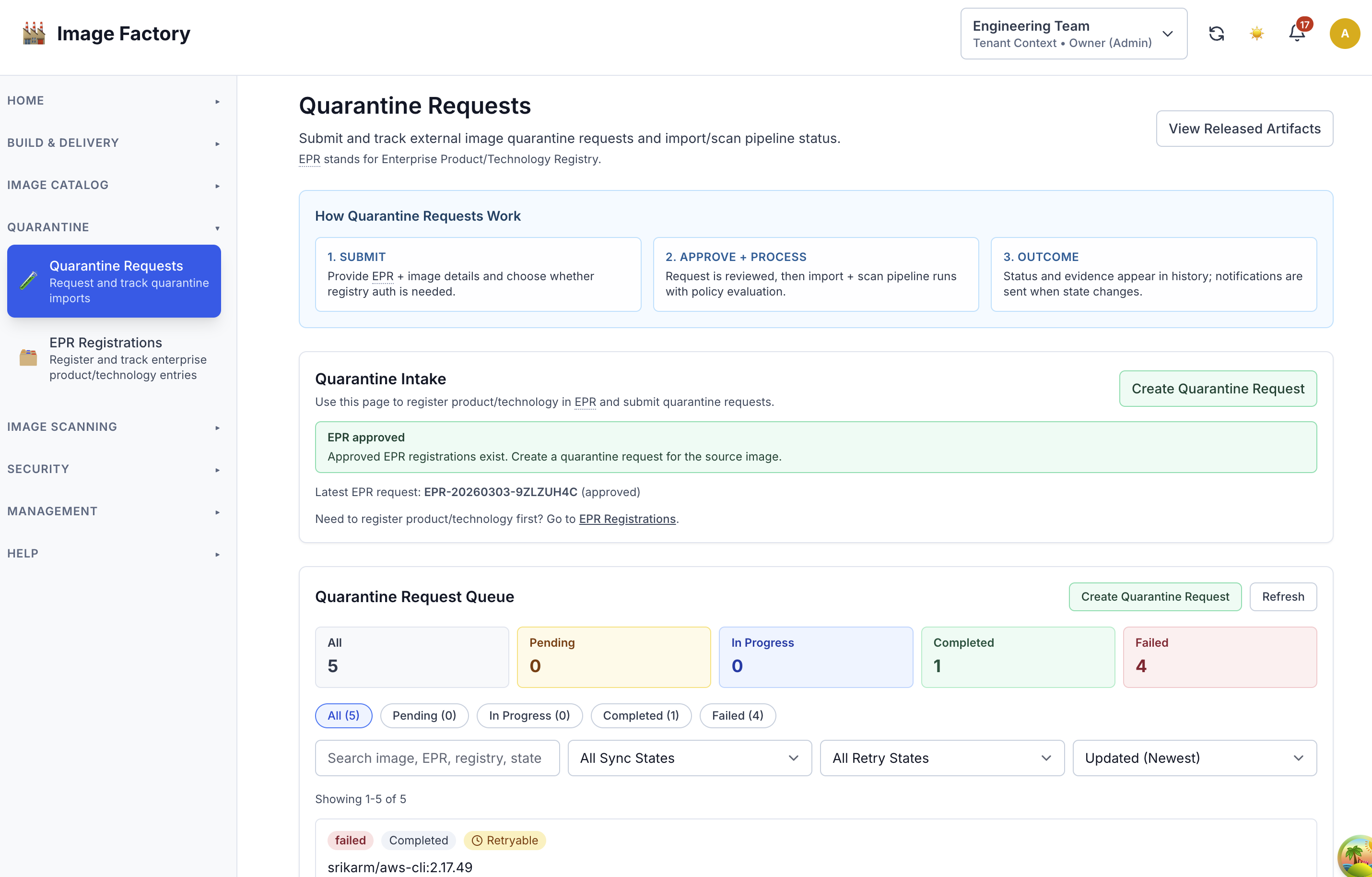
On-demand image scanning:
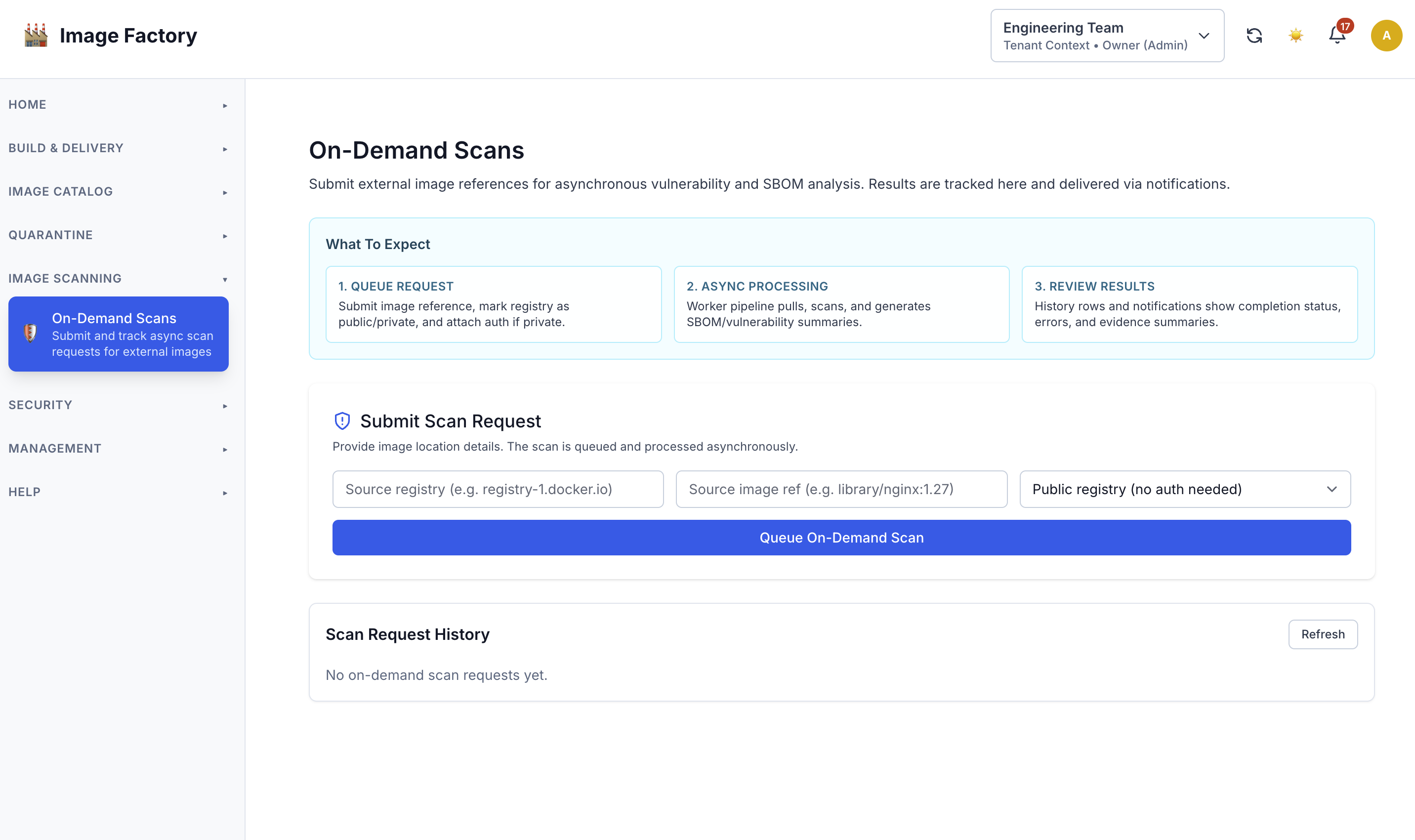
Admin Responsibilities
- Set tenant operation capabilities via:
Admin -> Access Management -> Operational Capabilities(primary surface)- tenant onboarding/edit (shortcut path)
- Configure EPR policy (
enforce,runtime_error_mode). - Configure quarantine policy:
mode:enforceordry_run- thresholds (
max_critical,max_p2,max_p3,max_cvss) - severity mapping (
p1..p4)
- Configure infrastructure providers with:
tekton_enabled=truequarantine_dispatch_enabled=true
- Review dispatch-readiness blockers via:
GET /api/v1/admin/infrastructure/providers/{id}/quarantine-dispatch-readiness
- Review denial telemetry and release metrics in admin stats/dashboard.
- Tune runtime services settings in System Configuration.
Tenant Responsibilities
- Submit quarantine import request only when entitled.
- Provide valid EPR record where required.
- Track request execution state and approval/import progression.
- Use on-demand scanning only when entitled.
- Use withdraw/clone actions for pending/retry workflows.
Reviewer Responsibilities
- Review EPR registration requests and approve/reject.
- Review quarantine import requests and approve/reject.
- Release only requests that are
ready_for_release. - Use blocker context (
release_blocker_reason, failure class/code, remediation hints) before acting.
Effective Admission Rules
- Capability denied:
- HTTP
403 tenant_capability_not_entitled- tenant trigger is
quarantine_request(external import path is part of the same flow)
- HTTP
- EPR prerequisite denied:
- HTTP
412 epr_registration_required
- HTTP
- Denied requests are side-effect free:
- no approval creation
- no dispatch/runtime mutation
End-To-End Flow (Current)
flowchart TD
    A[Tenant starts Quarantine Intake] --> B{EPR exists and approved?}
    B -- No --> C[Submit EPR Registration]
    C --> D[Security Reviewer Approves/Rejects EPR]
    D -- Approved --> E[Create Quarantine Request]
    D -- Rejected --> Z1[Stop with actionable denial]
    B -- Yes --> E
    E --> F[Security Reviewer Approves/Rejects Request]
    F -- Rejected --> Z2[Terminal: failed/rejected]
    F -- Approved --> G[Dispatch to eligible Tekton provider]
    G --> H{Pipeline terminal?}
    H -- No --> H
    H -- Yes --> I[Persist policy + scan + SBOM + digest evidence]
    I --> J{Release eligibility gate}
    J -- Blocked --> K[release_not_eligible + blocker reason]
    J -- Eligible --> L[Reviewer Release]
    L --> M[Terminal: released / consumable]
Execution and Release State Model
Execution progression (API contract):
awaiting_dispatchpipeline_runningevidence_pendingready_for_releasecompleted
Release projection:
not_readyready_for_releaserelease_approvedreleasedrelease_blocked
Key release blockers:
policy_not_passedevidence_incompleteevidence_stalepolicy_quarantinedimport_failed
Policy Behavior
enforce: violations drive quarantine outcome.dry_run: policy evaluated and recorded but does not block success the same way.- Policy snapshots are persisted for deterministic auditability.
Notifications and Idempotency
- Lifecycle events cover approval and terminal outcomes.
- Notification subscriber stores receipts and prevents duplicates.
- Replay/restart contracts are implemented to avoid duplicate tenant notifications.
- Failure notifications include
failure_class/failure_codeand actionable hints. - Escalation behavior:
dispatch,auth,connectivity,runtimefailures escalate to system admins.policyfailures remain tenant-scoped.
Runtime Services Hardening (Completed)
- Structured
field_errorsreturned for save-time validation failures. - Validations include:
- receipt cleanup bounds
- provider watcher bounds/relationships
- Tekton cleanup counts
- service ports + health timeout
- Tekton cleanup schedule (cron format check)
- runtime service URLs (
http/https, absolute, non-empty, host required)
- UI maps and clears field-level errors inline (light/dark ready).
Where To Configure
- Admin Access Management:
Operational Capabilities
- Admin System Configuration:
Quarantine PolicyEPR RegistrationRuntime Services
- Admin Infrastructure Providers:
tekton_enabledquarantine_dispatch_enabled
- Tenant image workflows:
- quarantine request flow (triggers import + scan pipeline)
- image security tab (on-demand scan)
Retry/Recovery Rules
- Retry is bounded by failure class policy.
- Backoff responses:
429 retry_backoff_activewithretry_after_seconds.
- Attempt limit responses:
409 retry_attempt_limit_reachedwithmax_attempts.
- Suggested tenant path when capped: clone request after remediation.
API Contracts To Watch
- Create request denial:
tenant_capability_not_entitledepr_registration_required
- Retry denial:
import_not_retryableretry_backoff_activeretry_attempt_limit_reached
- Release denial:
release_not_eligiblewithrelease_blocker_reason
Linked Operational Docs
- Capability journey: ../user-journeys/QUARANTINE_CAPABILITY_JOURNEY.md
- Operational capability definitions matrix: OPERATIONAL_CAPABILITIES_MATRIX.md