System Overview
This document summarizes the major runtime components, data flow, and integration surface of Image Factory at a system level.
Core Services
- Backend API: Multi-tenant core services, RBAC, build orchestration.
- Frontend UI: Tenant and admin experience for projects, builds, and configuration.
- Dispatcher: Status-based queue processor that dispatches builds to executors.
- Executors: Local executors and Tekton-based execution for Kubernetes.
Operational Capabilities
- Multi-tenant project and build management
- Kubernetes and Tekton-backed execution through infrastructure providers
- Quarantine request and release workflows
- On-demand image scanning and asynchronous result tracking
- Notifications, audit-oriented workflows, and execution visibility
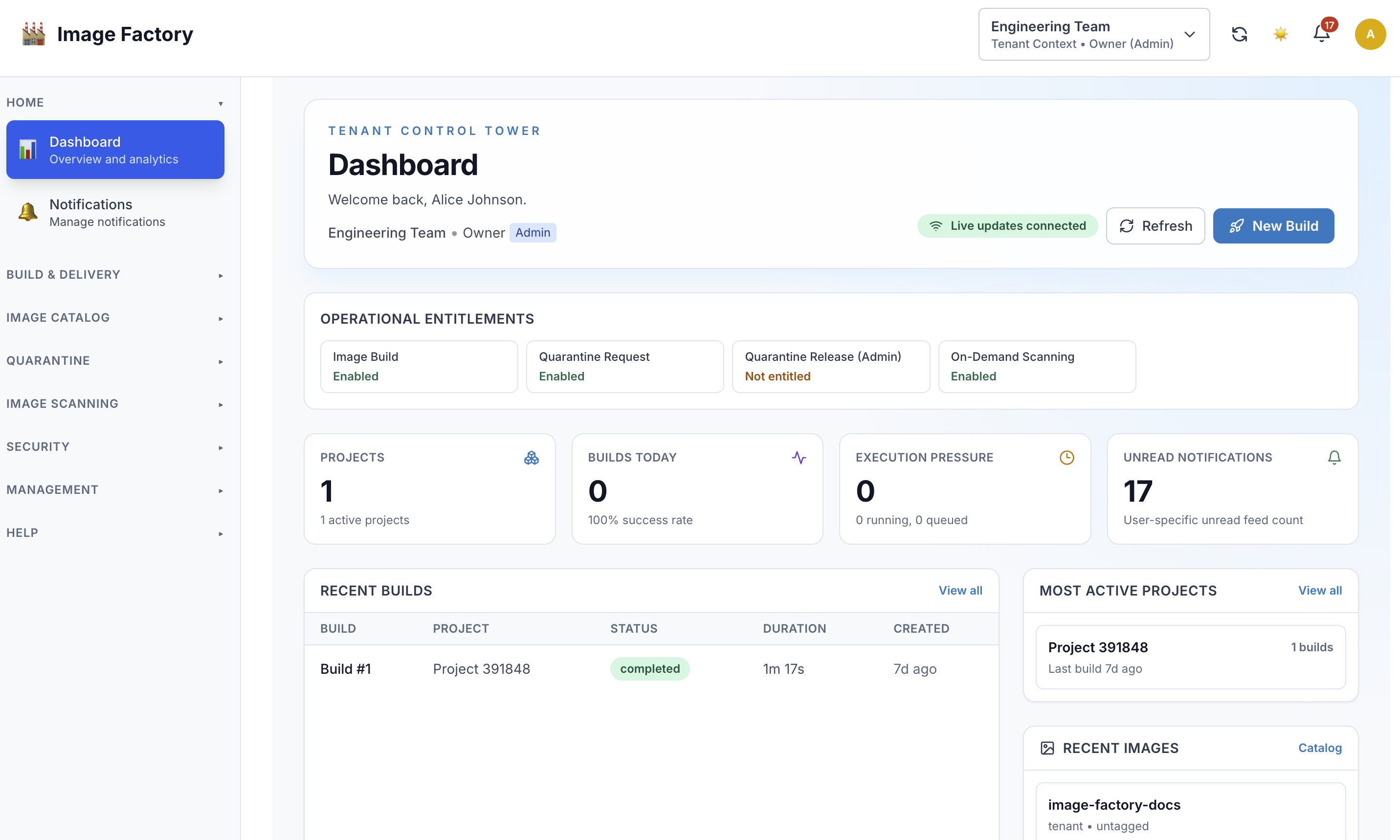
UI Snapshot
Tenant dashboard:
Runtime Architecture
flowchart LR
    U[Users] --> F[Frontend UI]
    F --> B[Backend API]
    B --> P[(PostgreSQL)]
    B --> R[(Redis)]
    B --> D[Dispatcher]
    D --> E[Executors]
    E --> T[Tekton And Kubernetes]
    B --> N[Notifications And Audit Flows]
Core Data Flow
- A user creates a build.
- Build is stored with
status = queued. - Dispatcher claims queued builds and starts execution.
- Execution emits logs, status updates, and artifacts.
sequenceDiagram
    participant User
    participant UI as Frontend UI
    participant API as Backend API
    participant DB as PostgreSQL
    participant Dispatcher
    participant Executor as Executor or Tekton

    User->>UI: Create build
    UI->>API: Submit build request
    API->>DB: Store build with queued status
    Dispatcher->>DB: Claim queued build
    Dispatcher->>Executor: Start execution
    Executor-->>API: Send status, logs, artifacts
    API->>DB: Persist execution updates
    API-->>UI: Return progress and results
Key Data Stores
- PostgreSQL: Source of truth for builds, configs, executions, and metadata.
- Redis: Caching/session (if enabled).
Integration Surface
- REST APIs for admin and tenant workflows.
- Eventing hooks for notifications and audit trails.
- Infrastructure-provider connectivity and readiness checks for Kubernetes execution.
Security & Access
- Tenant isolation with RBAC.
- Admin vs tenant-level access boundaries.
- Capability-gated workflows for build, quarantine, release, and scanning surfaces.